A Year with Alexander Pope (18) – a favourite…

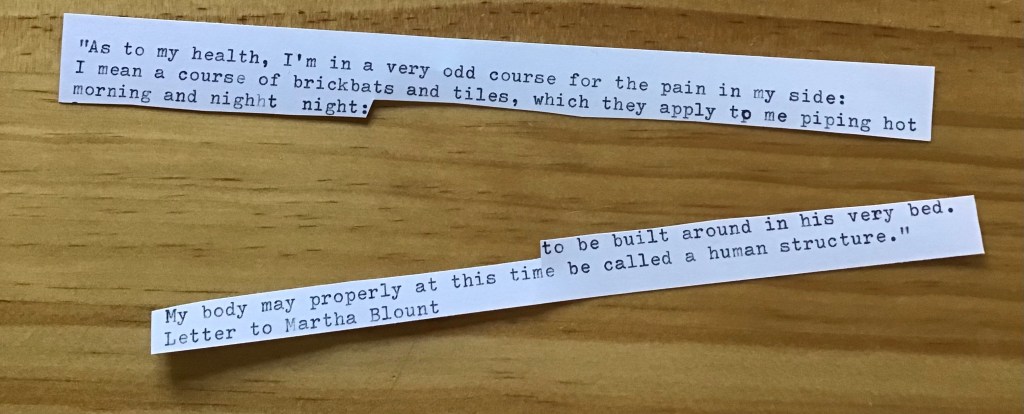
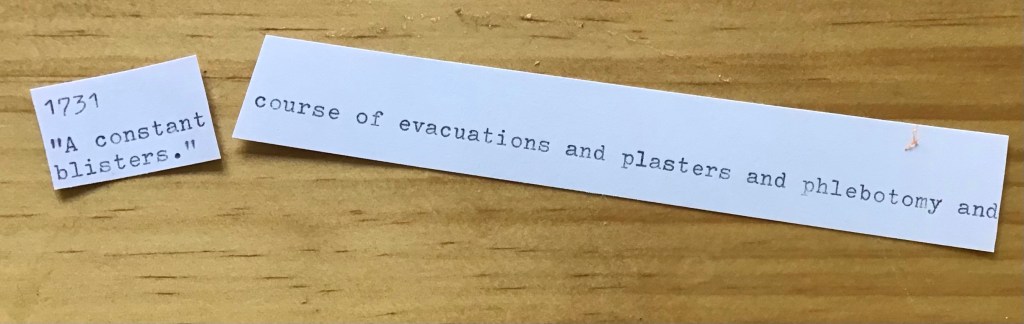
Of all the poems by Pope that I’ve read this is the one that I love the most. George I was crowned on October 20th 1714 so that places the event in time though the poem is dated to 1717. The young lady is Teresa Blount, who with her sister Martha were long-standing friends of Pope since his youth.

She went, to plain-work, and to purling brooks,

Old-fashion’d halls, dull aunts, and croaking rooks,

She went from Op’ra, park, assembly, play,

To morning walks, and pray’rs three hours a day;”

What I love about is how it captures the life of the young female members of the squirearchy in the eighteenth century so vividly. Pope’s teasing tone captures the immense tedium which must have been the day-to-day experience of many young women only occasionally interspersed with the excitement of London life.

What it reminds me of are two works which date from sixty years later but reflect exactly this world of the rural lower gentry. One is Goldsmith’s ‘She Stoops to Conquer’ of 1773 and the other is Sheridan’s ‘The School for Scandal’ of 1777. Consider this dialogue from ‘The School for Scandal’ in which Sir Peter Teazle confronts his young wife about her expensive lifestyle and reminds her of her previous rural upbringing.

How wonderful to get this poem in the post…
A Year with Alexander Pope (17) – Thank you for the lovely pens.

A much appreciated gift…..

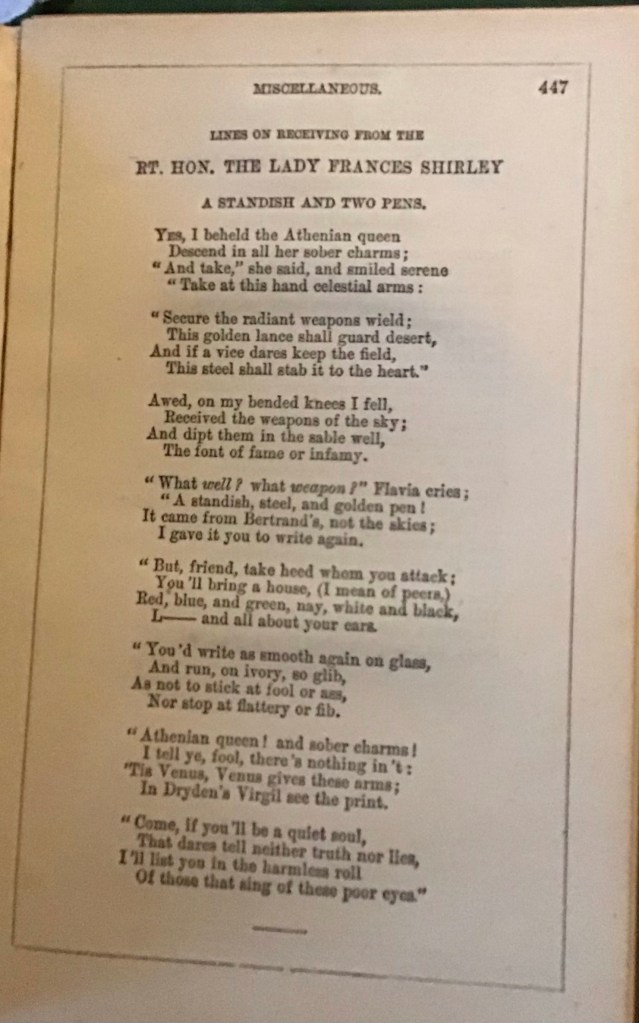
Pope wrote this poem quite late in his life around 1739 (only five years before his death). It’s a thank you note and a very handsome one too addressed to Lady Frances Shirley (1707-1778), the daughter of one of Pope’s neighbours in Twickenham, Earl Ferrers, and a noted beauty.

Pope considers himself armed for the fray by the gift even though the giver reminds him the gift is simply two pens, one steel and one gold and a standish (usually a combined pen dish and inkwell) bought in Bertrand’s. We learn a little more about the context of the gift from the next part of the poem where we hear the giver makes the gift in order that,

“I gave it you to write again.’ There’s a caveat though – the giver warns Pope to be careful who he attacks lest he brings a house (of peers) down upon himself.

It’s this that allows us to place this poem in Pope’s timeline. It was probably 1739 that saw Pope working on the ‘Epilogue to the Satires’ which brought him close to sanction and punishment by the House of Lords. The gift seems to be an encouragement to Pope to keep writing regardless.

I’m guessing that Bertrand’s where the gifts were bought might well be the well-known shop in Bath – a well-known toy shop. ‘Toyshop’ here is a false friend – in Pope’s time it referred to a shop selling luxury goods and trinkets, stationery and jewellery and items for the house.

A Year with Alexander Pope (16) – Eternal Sunshine of the Spotless Mind

Spot the film title…

2004 saw the release of Michael Gondry’s sci-fi/romance film ‘Eternal Sunshine of the Spotless Mind.’ The film tells the story of Joel and Clementine (Jim Carrey and Kate Winslet) who undergo a mind erasure procedure to erase all memories of their relationship after its end.

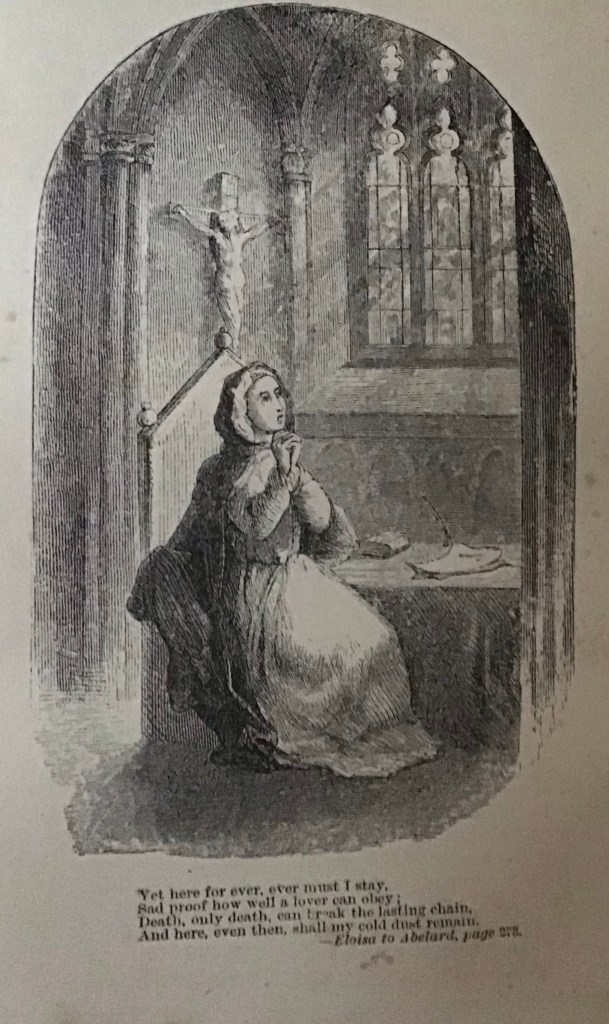
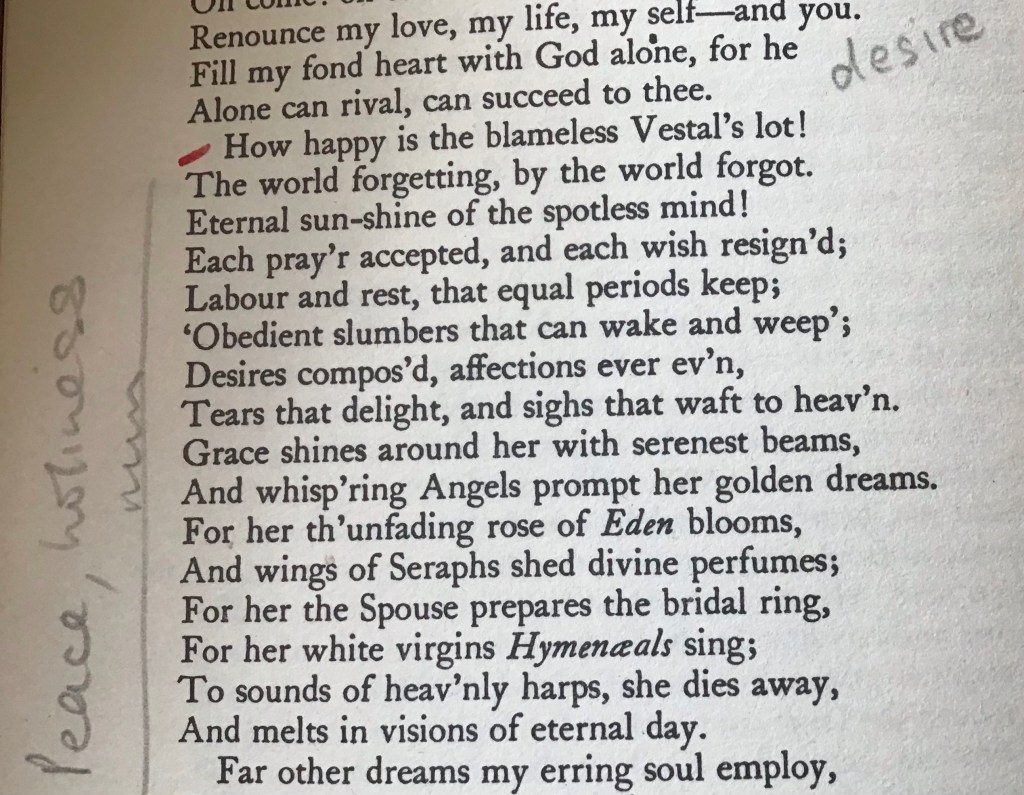
The title is from Pope and a very apt quotation it is. It occurs in a passage from Pope’s 1717 poem ‘Eloisa to Abelard’ – a passage where Eloisa longs for, idealises the life of the nun as a kind of perfect oblivion. She longs too for a deep acceptance of the religious life which must she believes leads to peace.

It is too, I suppose, a poem which longs for forgetting. Wanting to forget and to remember.

Pope’s poem is a reworking of the twelfth century lives of theologian Peter Abelard and his lover Heloise. The story had a long history and imaginative hold already by the time Pope chose to retell it. The love affair and illicit marriage of Abelard and Heloise, their forced separation, brutal attack on Abelard leaving him castrated and the two entering the religious life.

Pope’s poem begins long after the events told above. He calls his poem ‘Eloisa and Abelard’ unusually placing Eloisa at the front of the story and it is her voice we hear. Long after their love affair and separation Eloisa reads a letter giving Abelard’s account of their love and is plunged into a reflection into the love and despair of that time and the life that is now hers.

Pope’s last lines of the poem addressed to any future bards who might wish to retell or add to the story ends with the line,

‘He best can paint them who shall feel them most.’

This seems to have been seen as a challenge as a flurry of poems were to appear over the next few years retelling the story, mostly this time from the point of view of Abelard.

A Year with Alexander Pope (15) – the job of a poet.

Aided by notes from a 1960s English lesson.

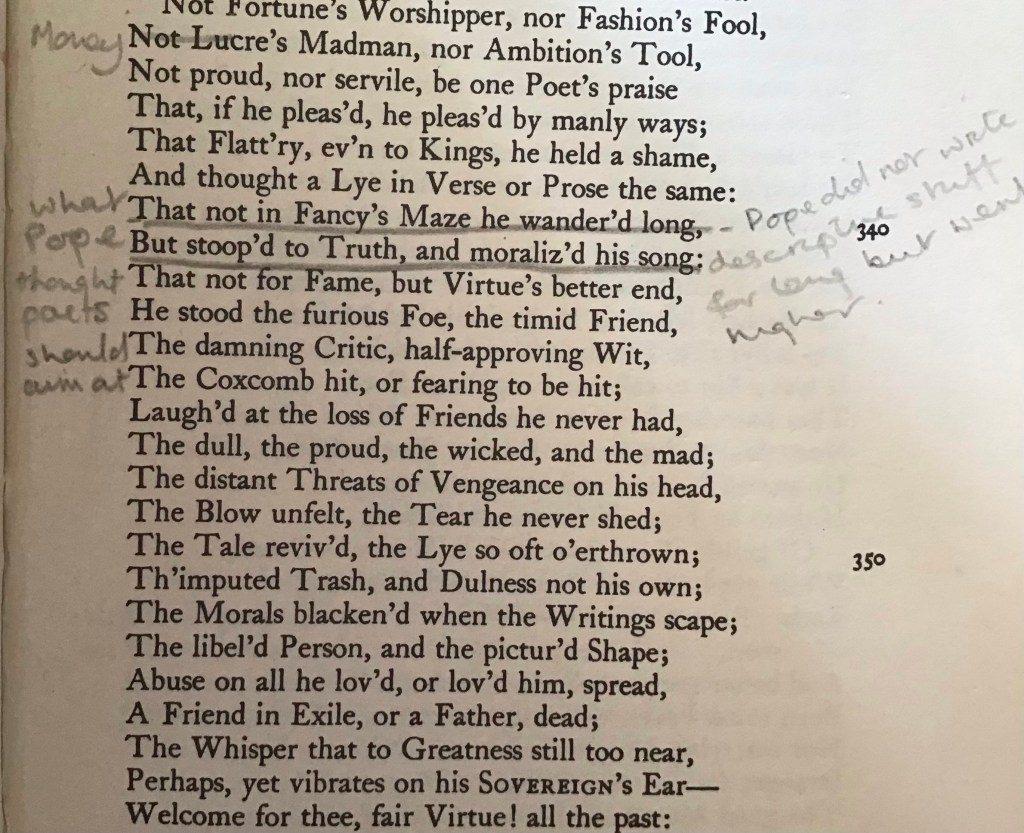
In his ‘Epistle to Dr. Arbuthnot’ written in 1734 and published the year after was Pope’s response to the news from his friend Arbuthnot, doctor and wit, was terminally ill. Pope saw this work as memorial and homage to the friendship and an opportunity to capture and defend his role as poet and satirist.

The section above captures how Pope saw those roles and the real feelings that underpinned how he saw himself as aiming for a successful withstanding of the attacks of his enemies for a higher ideal of work. This copy comes from a 1960s school textbook and an enthusiastic pupil has caught the message and written it alongside.

Just a final note on the epistle – it also gives us the phrase ‘damn with faint praise’ and the memorable ‘who breaks a butterfly upon a wheel?’

A Year with Alexander Pope (14) – a graduation

Where was Pope on June 30th 1743?

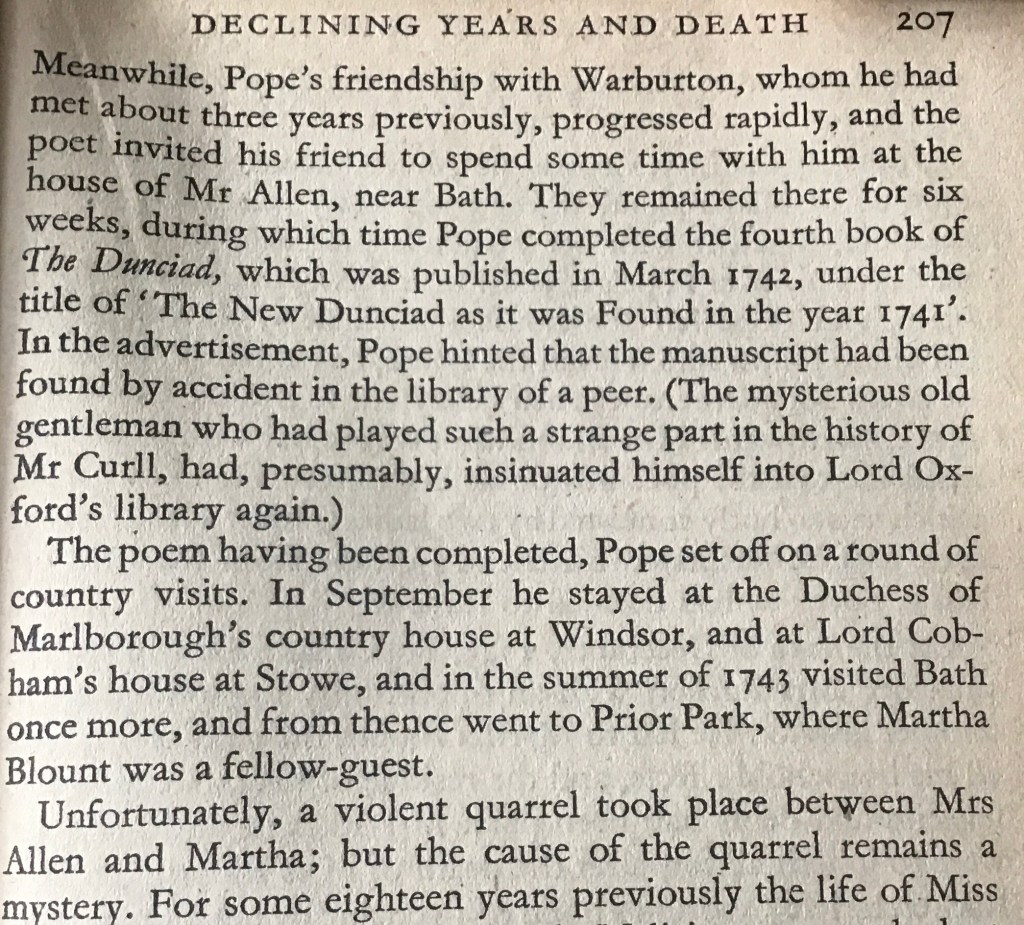
By 1743 Pope was a year away from his death and suffering greatly with his health – his asthma, urinary problems and episodes of pain were causing him considerable problems. We know that he spent the summer of 1743 staying with his friends the Allens at Prior Park near Bath (see above)

But a chance discovery by an antiquarian bookseller Mr Charles Bartlett of Winchester tells us something Pope definitely did do in June 1743. At a local sale in Alton Bartlett bought a set of the six volumes of Pope’s translation of the Iliad and inside found the following inscription in the naturalist Gilbert White’s hand.

Given to me by Mr. Alexander Pope on my taking my Degree of B.A. June 30th 1743

Gilbert White (1720-1793), great observer of the environment around his home and pioneer ecologist, was at the beginning of his career as Pope’s life was beginning to draw to a close. The exact circumstances of the gift, whether it involved a meeting or a mutual friend are unknown but it is a tiny, welcome link between two great eighteenth century figures.

I also find it a touching and generous gift. His Roman Catholic origins had prevented Pope from attending university and this gift to a new graduate seems a particular kindness.

A Year with Alexander Pope (13) – back to The Rape of the Lock

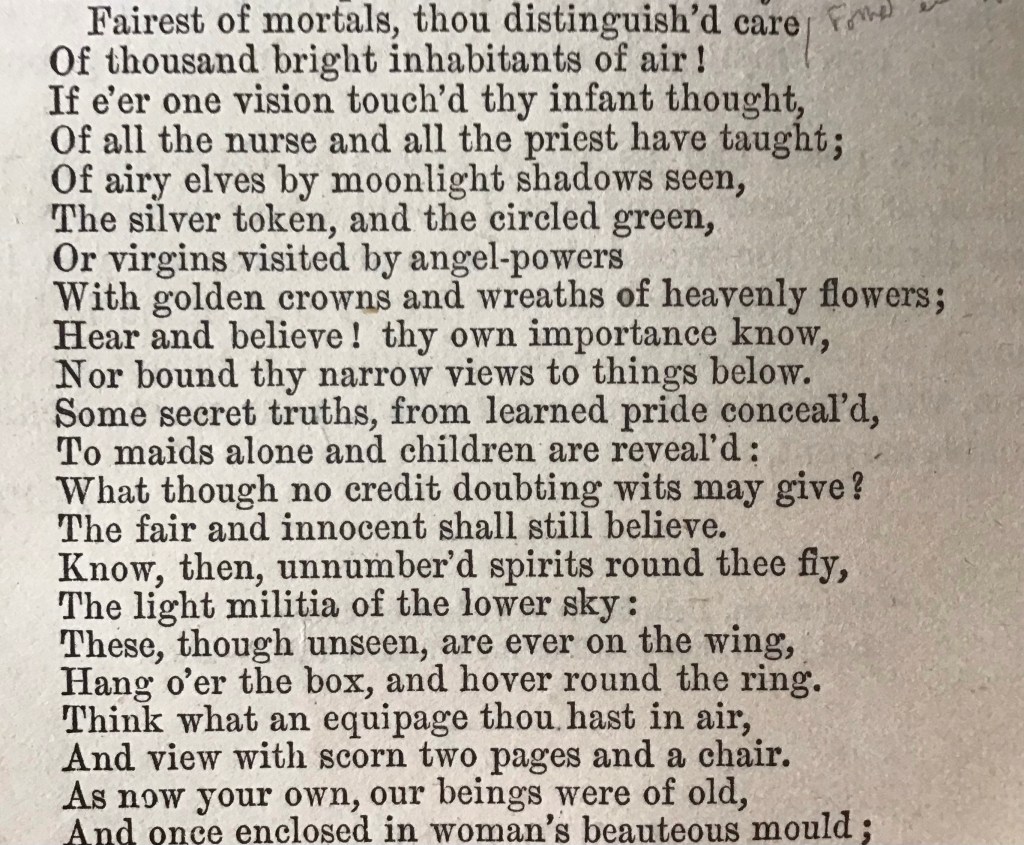
I’ve chosen this section from early on in Canto One of The Rape of the Lock because for me it captures what is the essential wonder of the poem. I love the idea that the central absurdity of a true life event which saw a broken engagement and a rift between two families over the illicit cutting of a lock of hair could inspire a poem at all. Add to that the idea that writing the poem was suggested to Pope to potentially help the situation; this seems to me particularly wonderful.

One of my favourite lines is in this section of the poem – “Know, then, unnumber’d spirits round thee fly, The light militia of the lower sky.” I love particularly the idea of this protective world of fairies and spirits around Pope’s heroine. Pope hopes here, I think, to create and lift the mood, to begin a fairy tale. It’s a long way from the serious rift which had split two families apart.

I love the idea of a light militia of the lower sky looking out for us though…

A Year with Alexander Pope (11) – The Rape of the Lock

Just wonderful….

Whatever else it is, Pope’s poem is beautiful, light and lyric. It belongs completely to the extraordinary energetic time in which it was written. It’s also something to think that someone might be asked to write a poem to bring a divided couple and two great families together again.

It appeared first in 1712 with just two cantos and with no author’s name attached, it was published again in 1714 with the full five cantos and under Pope’s name. The poem treats a small incident with mock heroic style a relatively minor incident – hence its often quoted first lines.

“What dire offence from amorous causes springs, what mighty contests rise from trivial things…’

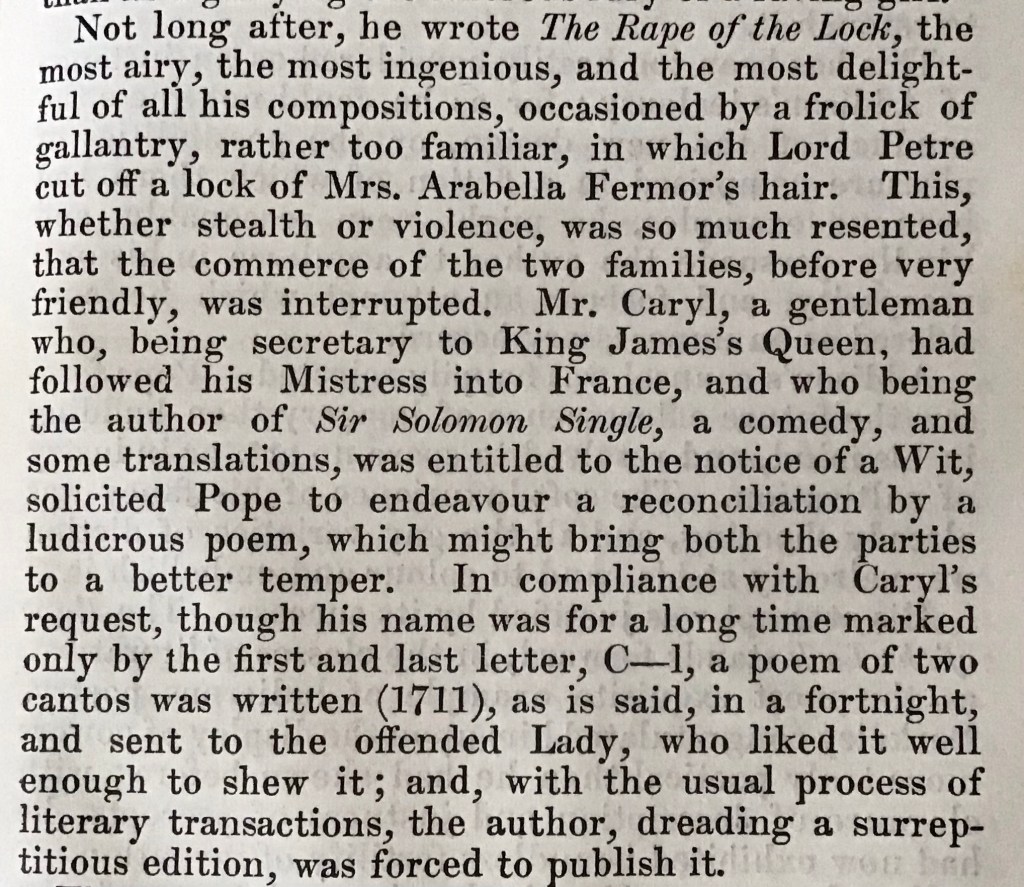
Johnson in his ‘Lives of the Poets’ had no doubt of its beauty and also reports the circumstances of its composition.

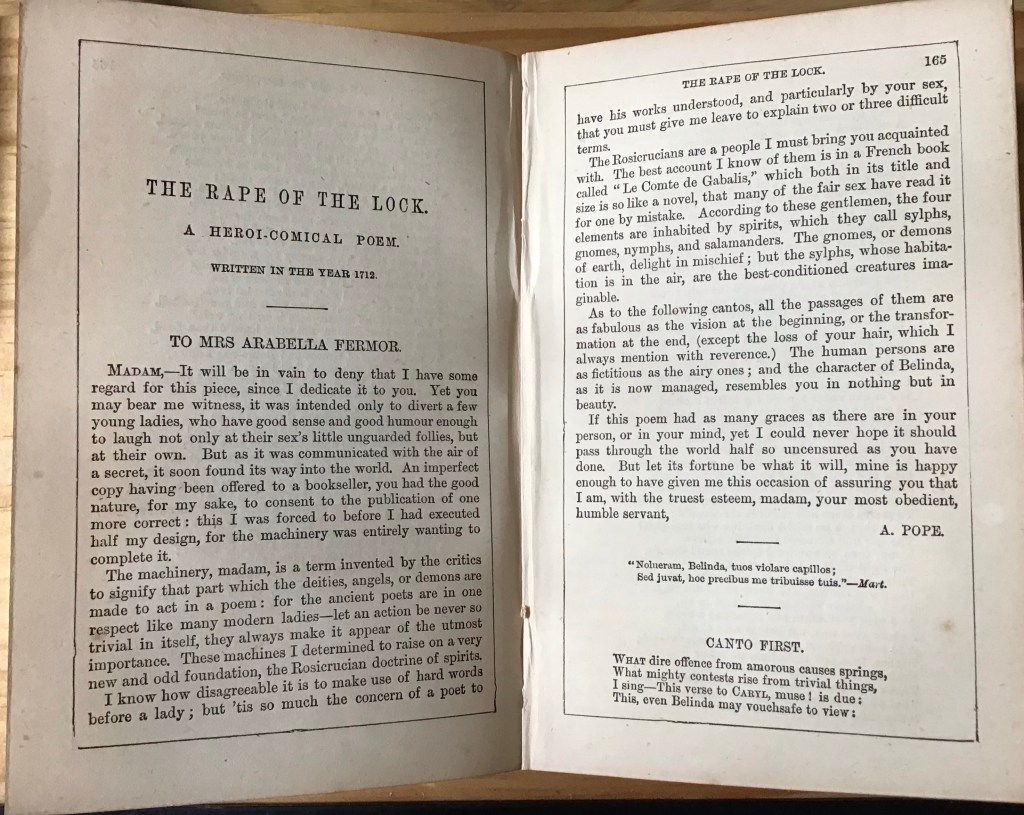
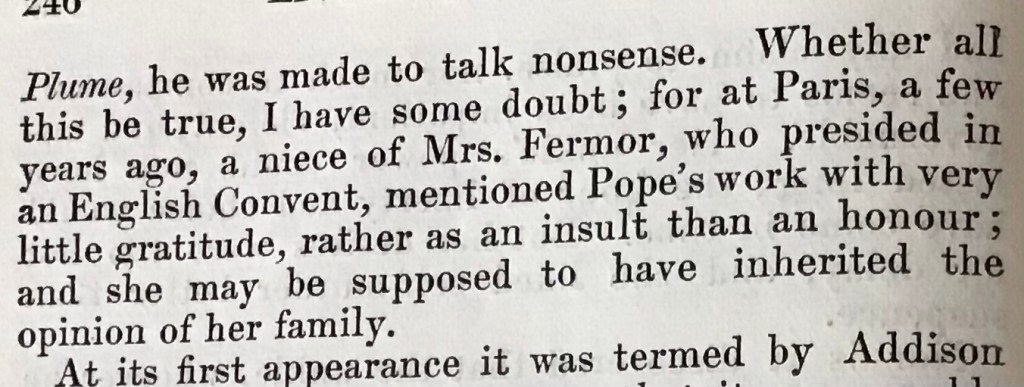
Arabella Fermor was a noted beauty and was engaged to Lord Peter when he work a step too far by cutting without permission a lock from her hair. A rift between the couple and between the families followed and it was suggested to Pope a poem could be an instrument of reconciliation. Here’s Pope’s preface…

Neatly put…

Its virtue in the end is as enduring poetry because there was no reconciliation; Arabella Fermor married someone else and her family, according to Johnson were less than delighted.

More on ‘The Rape of the Lock’ next time.

A Year with Alexander Pope (10)

Where does Pope fit in?

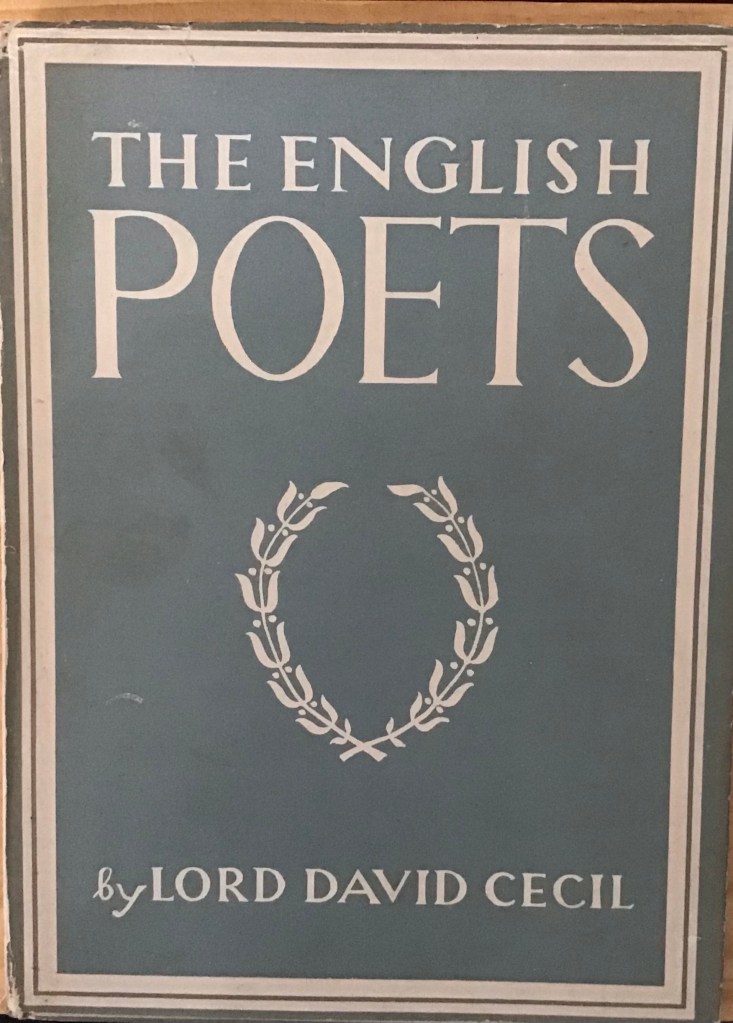
As part of the much loved and much collected ‘Britain in Pictures’ series Lord David Cecil contributed ‘The English Poets’ (1942, this reprint 1943). The book offers a concise (48 pages) chronological account of what Cecil considered the key figures and themes of English poetry. Cecil saw something intrinsic in English as a language which made it especially suitable as the language of poetry.

“English is a poet’s language.”

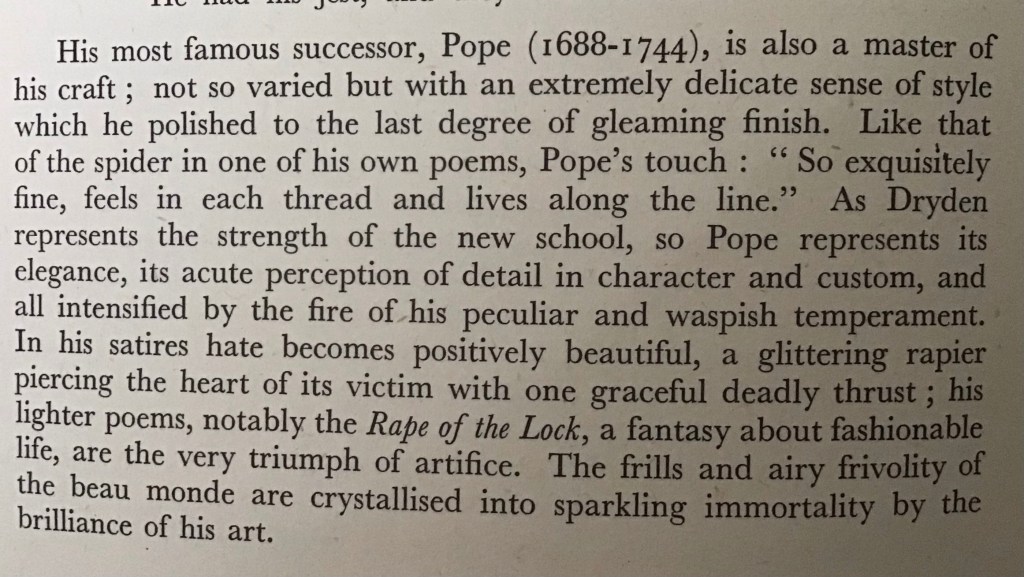
When he reaches Pope around p. 22 it is immediately after Dryden (1631-1700). Cecil saw Dryden as marking the beginning of a new era; a previous era ending with the work of Milton. Whereas, Cecil noted, Milton had lived in a period of civil and religious wars, Dryden and Pope lived in a settled civilisation in the late seventeenth and eighteenth centuries.

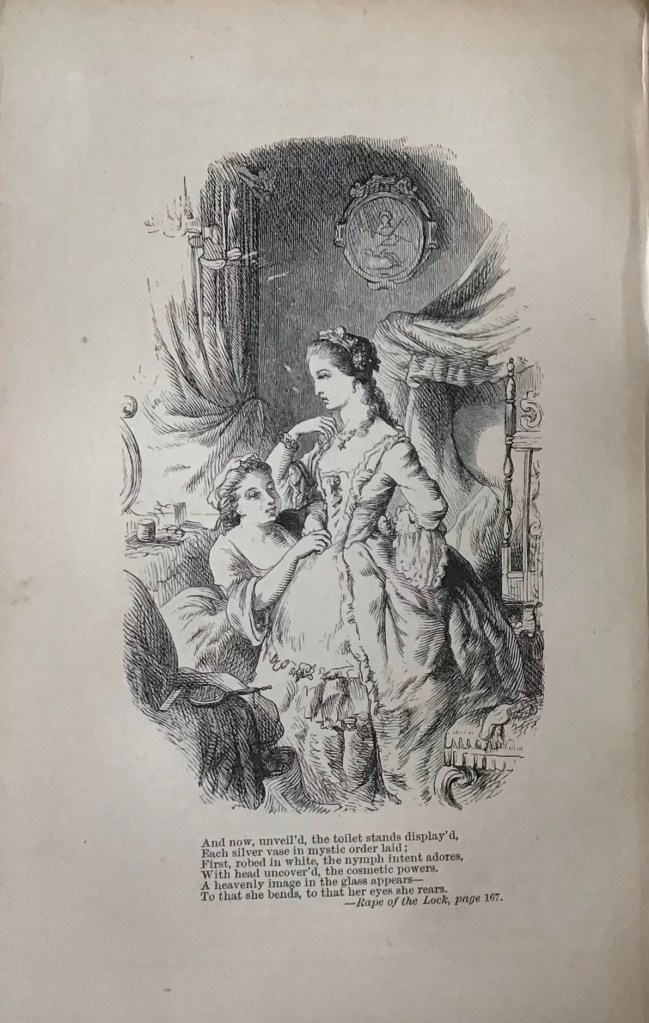
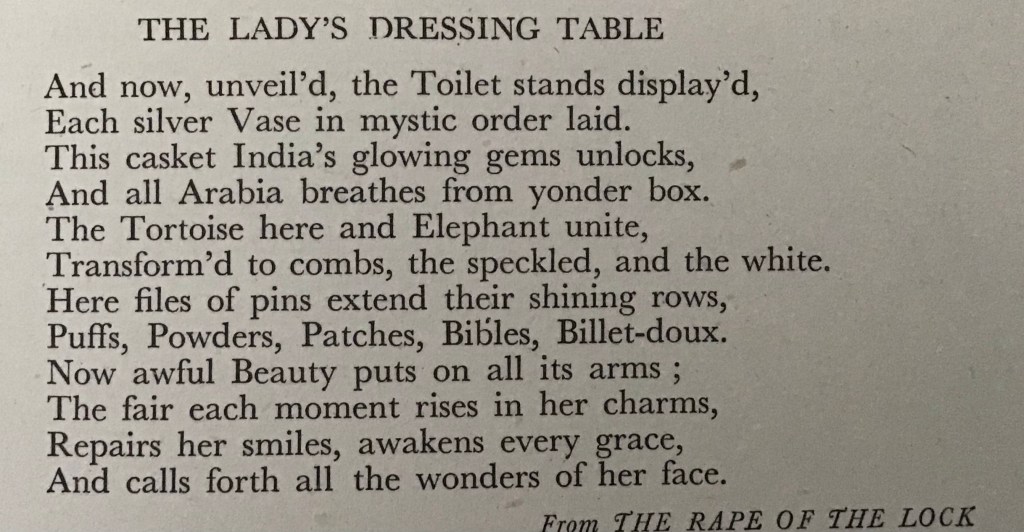
The beauty and lightness of the mock heroic style embodied in ‘The Rape of the Lock’ can only belong to that sort of time and society. Only an acceptance of the society as is, with its customs and tastes, could have produced this description of Belinda’s dressing table…