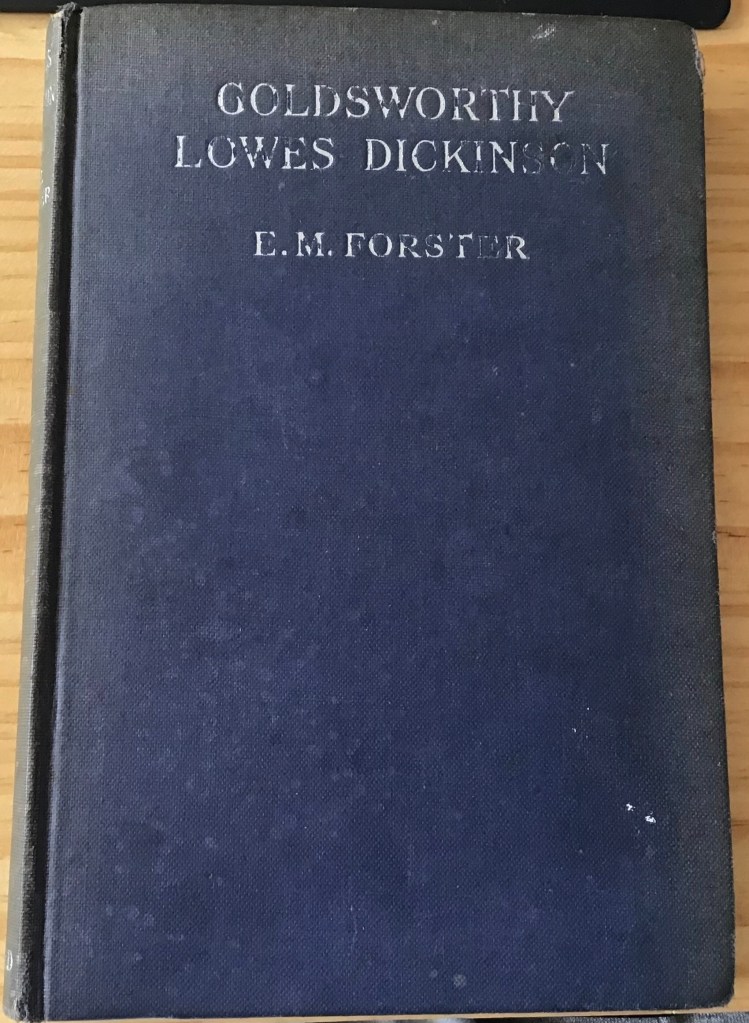
Forster’s book of essays ‘Abinger Harvest’ brought me to this book – Forster’s biography of his friend Goldsworthy Lowes Dickinson. Dickinson (1862-1932) was a Cambridge fellow, political scientist and philosopher. Among his achievements were the ideas he developed in the First World War for a League of Nations which came to be very significant in the postwar period.
I want to write about this book, however, less for its subject matter than for what it tells us about the art of biography. Forster was a close friend of Dickinson and his literary executor but in a book of extraordinary honesty approaches the task of biographer full of reservations about his own shortcomings. Which makes it a fascinating read.
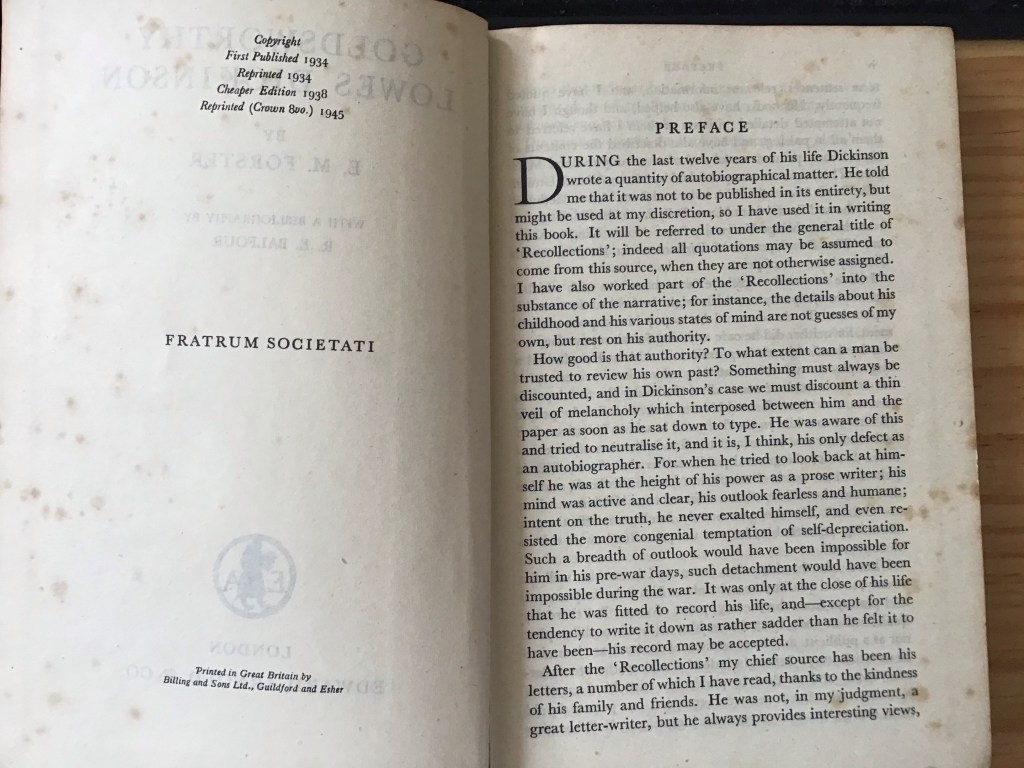
In the preface Forster confronts the challenge his friend presents him with and sets himself a laudable goal, “I should like to make him live for people who never met him in the flesh.” Forster’s book is a book about character and nature. It is an exploration of a sensitive nature and the struggle, one of some length in Dickinson’s case, of finding one’s metier.
It epitomises Forster’s style and attitude that as he explores the three writers that meant so much to Dickinson throughout his life – Shelley, Plato and Goethe – he wonders if the fact that these writers have never meant much to him is a significant barrier to writing the biography at all.
Again, Forster fears he cannot capture the technical nature of Dickinson’s career yet grabs the spirit of it absolutely with a phrase describing Dickinson as having a ‘suicidal sense of fairness.’ Forster fears too he has failed to show the lighter side to Dickinson but reminds us how futile it is to try to capture nonsense.
It’s a wonderful book and Forster chooses to put at the end several of Dickinson’s letters and I greatly loved the two letters written by Dickinson to Virginia Woolf full of the most overwhelming admiration for ‘The Waves’ – the second as he began to read it for the second time.

 The Solitary Reader