This post is a small deviation from books with titles taken from Milton. It was the previous one of those reads ‘Eyeless in Gaza’ that prompted me to think about pocket books. Towards the end of the novel the central character Anthony Beavis takes a trip to Mexico with his former schoolntains, friend turned traveller Mark Staithes.
The expedition involves long periods travelling by mule and that’s where the pocket book comes in. Staithes, we are told, has a pocket Shakespeare, a copy of the Tragedies. Twice in their arduous trek we hear of Staithes reading it while travelling. First, he reads ‘Timon of Athens’ spurring the mule every time he turns a page. Subsequently, as they continue to climb higher and higher into the mountains, Mark reads the whole of ‘Hamlet’ and two acts of ‘Troilus and Cressida.’
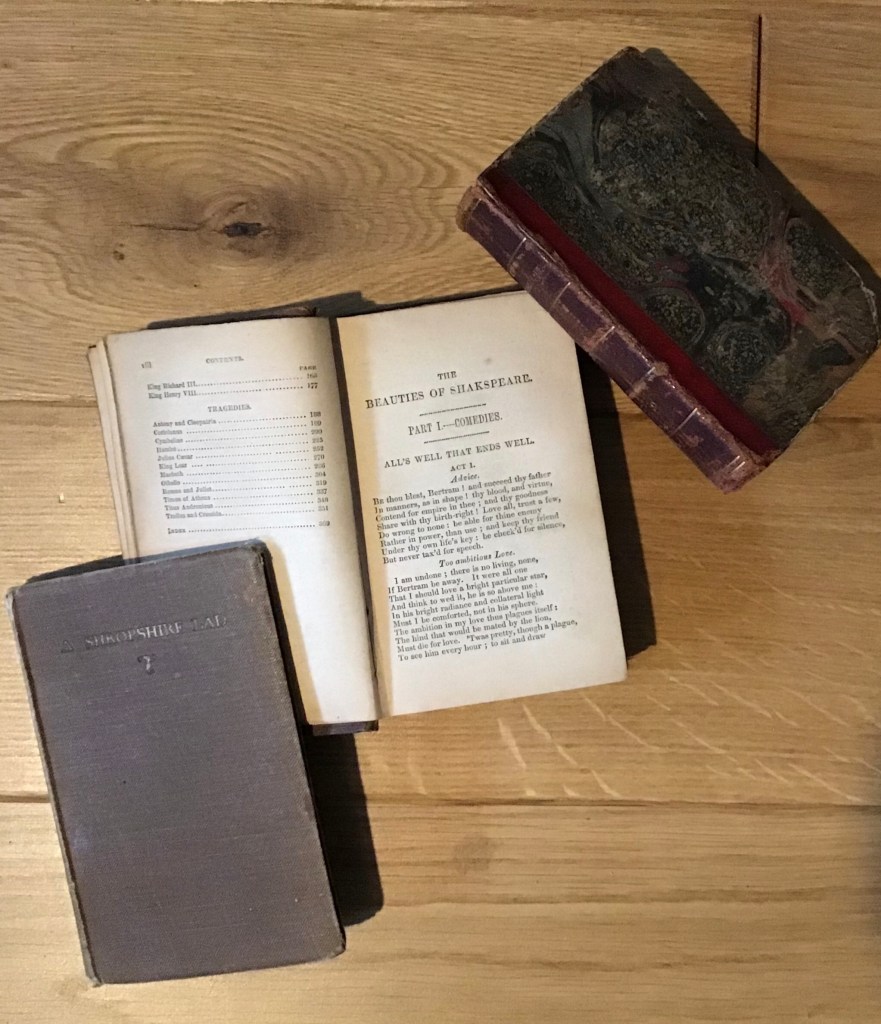
I was very pleased by these mentions because I like carrying a book all the time and I like pocket editions of anything very much. There’s a real attraction to the small. In the photograph are three of mine and I always carry one of these if I’m away from home. The Housman ‘A Shropshire Lad’ is small and slim and I’ve read it on numerous train journeys. My copy has a name inside and a 1941 date in pen so I always hope it’s owner got safely home too.
The other two are both Shakespeare. The smaller marbled book is volume nine of the Plays of Shakespeare in Miniature published in 1804 and contains ‘Titus Andronicus’ ‘Pericles’ ‘King Lear’ and ‘Othello.’ One the spine Shakespeare is spelled incorrectly without the first ‘e’. I wonder sometimes if this is an error or maybe usage was just less firm.
The open book is ‘The Beauties of Shakespeare’ by the Rev. William Dodd and my copy is from 1859. Dodd’s book is a fairly early anthology which gathers extracts from Shakespeare and groups them as Comedies, Historical Plays and then Tragedies and provides a wonderful and edifying index which helps the reader find suitable pieces on such as ‘ Study’, ‘Royalties, miseries of,’ Violets etc.
All great consolations.

 The Solitary Reader